A story by AJK and MVK
All artwork by Doubleleaf
A labor of love, written and illustrated by human hands. Contains no AI generated content. Features 27 original images.A driver's life is a quiet one. Cities pass like hazy memories, and people even faster. Andrei, a lost and bitter young man in a strange land, seeks reprieve from the solitude and monotony of his work. Just then, in a moonlit clearing, a fateful encounter gives his life renewed purpose.Monika, a volkodlak, a mysterious wolf woman of ancient lore, is trekking across country just to get back home. Through the night, they find in each other a kindred soul, lonely wanderers seeking answers to life's deepest questions. Her, a philosopher who sees everything as part of a vast cosmic order. Him, a free thinker who refuses to go the beaten path.A sudden offer, unexpected to them both, to give her a ride home, sets them on a weeklong journey. As the kilometers roll by, through mountains and plains, past rivers and valleys to the frigid lands of the north, they share pain, secrets, and a bed. Yet as they grow closer, more and more they see each other's flaws and follies, the cracks in their cultural divide, and the ghosts of their pasts.
Can two strangers, an immigrant and a werewolf, adrift in life, navigate the crossroads of their hearts?
Email us at:[email protected]
To learn more about the future of Truck and Traveler, about us, or our policies, please check the section below.

How you can support us
(QR-code to the website)We are indie authors with a debut novel. We are going against an ever-increasing number of AI-generated and mass-marketed novels made without heart or soul.Any amount of sharing goes a long, long ways. Word of mouth and sharing this story to your friends and cohorts helps more than you think. If you are interested in making a financial donation, please email us at the provided email. All funds will go towards the story of Truck and Traveler.
In the future once enough has been submitted, fan-works will be displayed in a separate section of this website here, including fanfiction, fanart, and other fan-created media. Full credits and links to artists will be provided. To submit art, email us at the provided email. AI-generated artworks will not be displayed.
We support all fan-works as long as they do not reimagine and/or plagiarize the original story. When creating fanworks and displaying in public media (i.e bluesky, twitter, deviantart, tumblr, youtube, etc) please credit us and the Truck and Traveler series. More information about our copyright policy can be section below.
Learn more about Truck and Traveler
Strania
The setting of Truck and Traveler.

Andrei Kuevas
Truck driver and immigrant.


Monika Volkova
Volkodlak and vagabond.
Andrei
Monika
Andrei Sergiovich Kueva
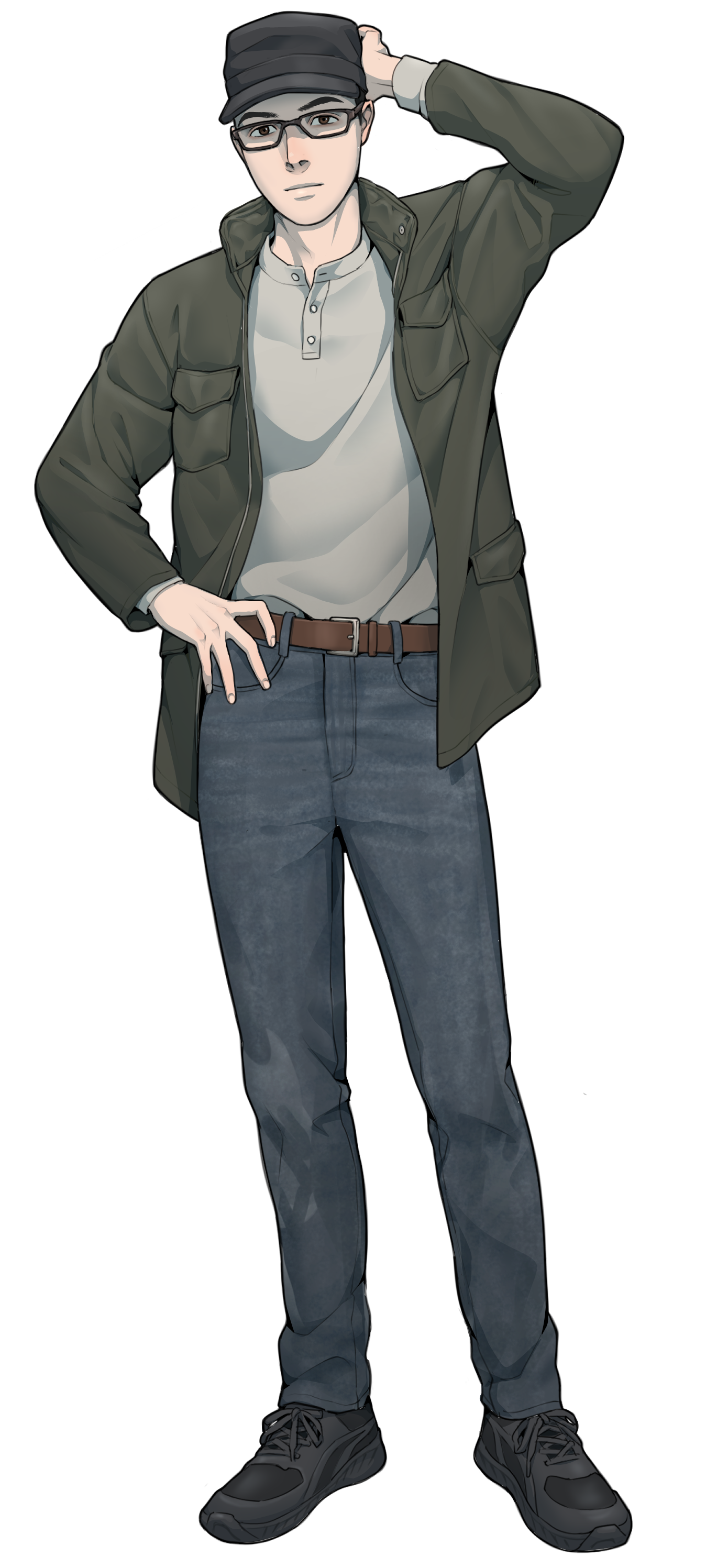
“You can talk to me as often as you need to.”Name: Andrei Sergiovich Kueva / Andreas Nestor Cueva
Age: Twenty oneOverview:
Truck driver and male protagonist of Truck and Traveler. Two years of driving have left Andrei feeling isolated and listless, let alone the twenty years he has spent alone. One night after being unable to sleep, Andrei wanders into a forest clearing. There he meets a fellow wanderer through life; Monika. The two agree to travel together to the city of Chel’bya so she can return home by the railway. Little did he know their journey would last for the rest of his life.Personality:
Quiet and reserved, Andrei avoids drawing attention to himself. While mild mannered and tempered, he is not immune to frustration; particularly when he feels misunderstood. Despite his reserved exterior, Andrei is highly expressive when he feels comfortable with someone. Despite his attempts to, he struggles to hide his true emotions on topics. Often speaking his mind once given the chance, and wearing his heart on his sleeve.Andrei is deeply guarded, being slow to trust and to reveal anything about his feelings. Though despite this guarded nature that often leads to him shrugging off others, he deeply craves connection and understanding, knowingly or otherwise. Even then, he isn’t sure how to navigate personal relationships, and so he has decided it is not worth trying.He is deeply introspective, often spending long hours reflecting on himself and the world around him. Thoughtful, he analyzes his motivations and emotions with surprisingly clarity. Though he can ignore his introspection for fear of causing himself more pain by reflecting.He is often hesitant when it comes to showing his true feelings on subjects. Afraid of being judged or misunderstood. And he is even more guarded with his pains and past. He does not form bonds with many, but when he does, he dedicates himself fully. Valuing honesty, loyalty, and support. Despite his reservation, he is deeply caring for people that matter to him. Listening intently to the pains and burdens of others to help carry them. His past makes him deeply conflicted on many matters, and self-doubt cripples his ability to connect with others.Background:
Born admist Eserikan interventionism in the middle east, Andrei’s father Sergio was deployed for much of Andrei's early childhood. Leading Andrei to be coddled by his mother for much of his early life. Sergio returned as Andrei was nearly ten, leaving Andrei to have to cope with suddenly having to deal with his father; and his harsh, overbearing behavior.Witnessing and being acutely aware of the flaws of his homeland, Andrei has become emotionally closed off and immensely self-conflicting. His later experience in Eserika only bolstered his disdain for his country, and furthered his growing fascination with Strania.At nineteen Andrei hastily left Eserika and began his immigration to Strania. Over the course of two years changing his name, becoming a truck driver, and obtaining a residency permit. Over the course of those two years Andrei has spoken to almost no one, and remained as much of a loner as he was in Eserika. Until a chance meeting with a fellow lost soul one autumn night.
Monika Terrovna Volkova
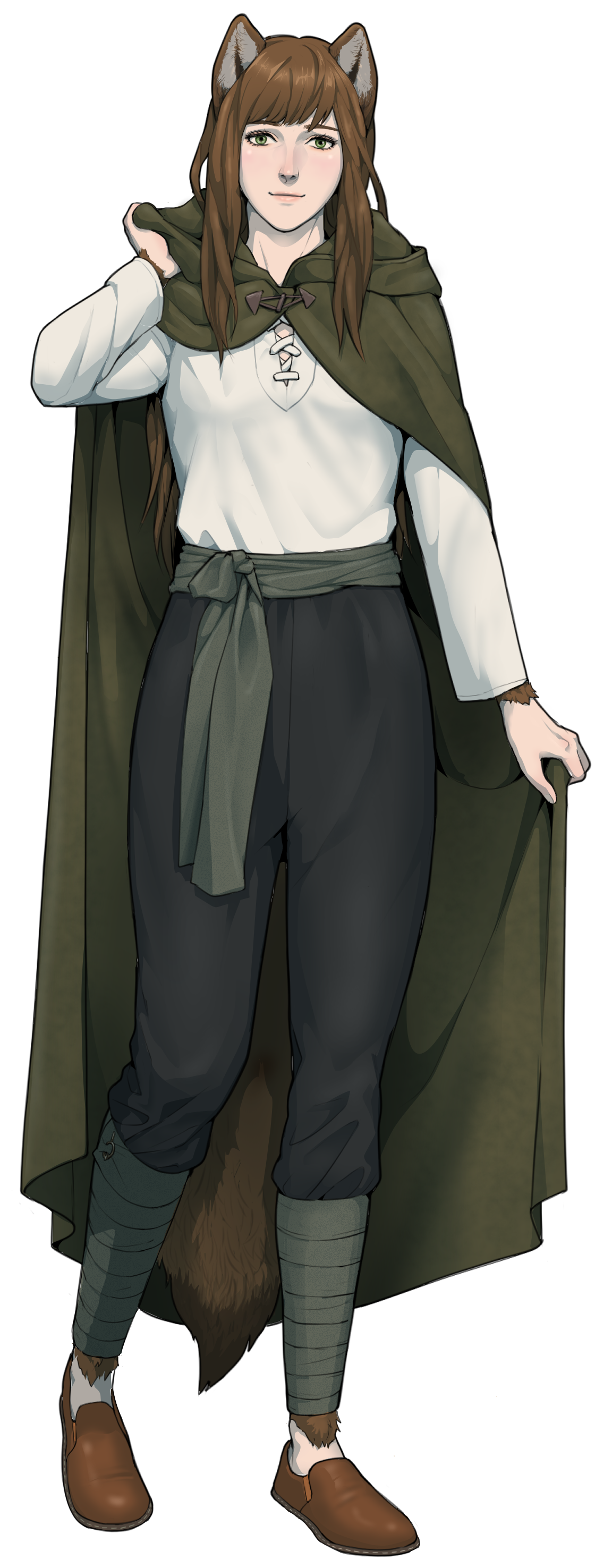
“Do you think things exist that we cannot prove?”Name: Monika Terrovna Volkova.
Age: Twenty sixOverview:
Wandering vagabond and heroine of Truck and Traveler. Monika is a volkodlak (волкодлак, lit' wolf's fur.) native to Northern Strania. By pure chance, after traveling alone for two years, she meets a driver by the name of Andrei in a forest clearing. When he offers to take her to a train station in Chel’bya a thousand kilometers away, she accepts. Beginning a journey that changes both of their lives forever.Personality:
Deeply introspective and acutely observant. Monika is often lost in her thoughts, and reflections. Though she deeply values honesty, she chooses to remain quiet when she believes her thoughts won’t be understood. Monika is contemplative rather than impulsive, and keeps her thoughts to herself unless she trusts someone enough to understand her. As it turns out, very few do. And so, she stays to herself, wandering through life alone.Having spent years in college honing her social skills, Monika is adept at maintaining surface-level relationships. With most regarding her as a cordial and pleasant person. However, she feels a crushing isolation, due to the persona she puts up, and lack of what is to her, real connection.
Despite her yearning for companionship and honesty, Monika hesitates to advance any relationship beyond a mere acquaintanceship; afraid of showing who she truly is, and burdened by a past trauma. Trapping herself in a cycle where she feels more alone the more she attempts to connect with others.She is self-conscious of her identity as a volkodlak, taking great care to hide her nature. She grows uncomfortable and frustrated when attention is drawn to her appearance. This self-consciousness also extends to moments of intimacy, where she often hesitates. She is sensitive to rejection and fears what might happen if someone sees her true self.Her youth in a village has lead to her admiring the quiet, slow paced life. And her various experiences from her past have left her despising the modern world and it’s fast paced, transient attitudes. Crowds and face-paced hectic lifestyles overwhelm her, and she feels she doesn’t belong in this new world.
Two years of traveling alone have exacerbated her struggles with forming close connections, only made worse by the gnawing emptiness and desire for connection she holds within her. Monika continues to travel, trying to face a place to belong in a world that doesn’t make sense to her. Until one night she finds someone just as lost in the world as her.Background:
Born and raised in the village of Selkärin, Monika has become accustomed to a slower pace of life. She spent her early years exploring forests, living her small family, and living a traditional rural Stranian life, all of which have left a deep impact on her.In her childhood, her village was discovered to have immense oil stores and as such was quickly settled by the corporation of Gazverm. Monika was forced to watch as her village was torn down and replaced by a new, alienating city, as the former inhabitants were gentrified and forced into a new life.After deciding to leave Selkärin, Monika wandered on foot across Central and Southern Strania for two long years. Walking from city to city, village after village, until one night, as if by fate, she finds a fellow wanderer in a forest clearing.
Strania - Land of the Stran

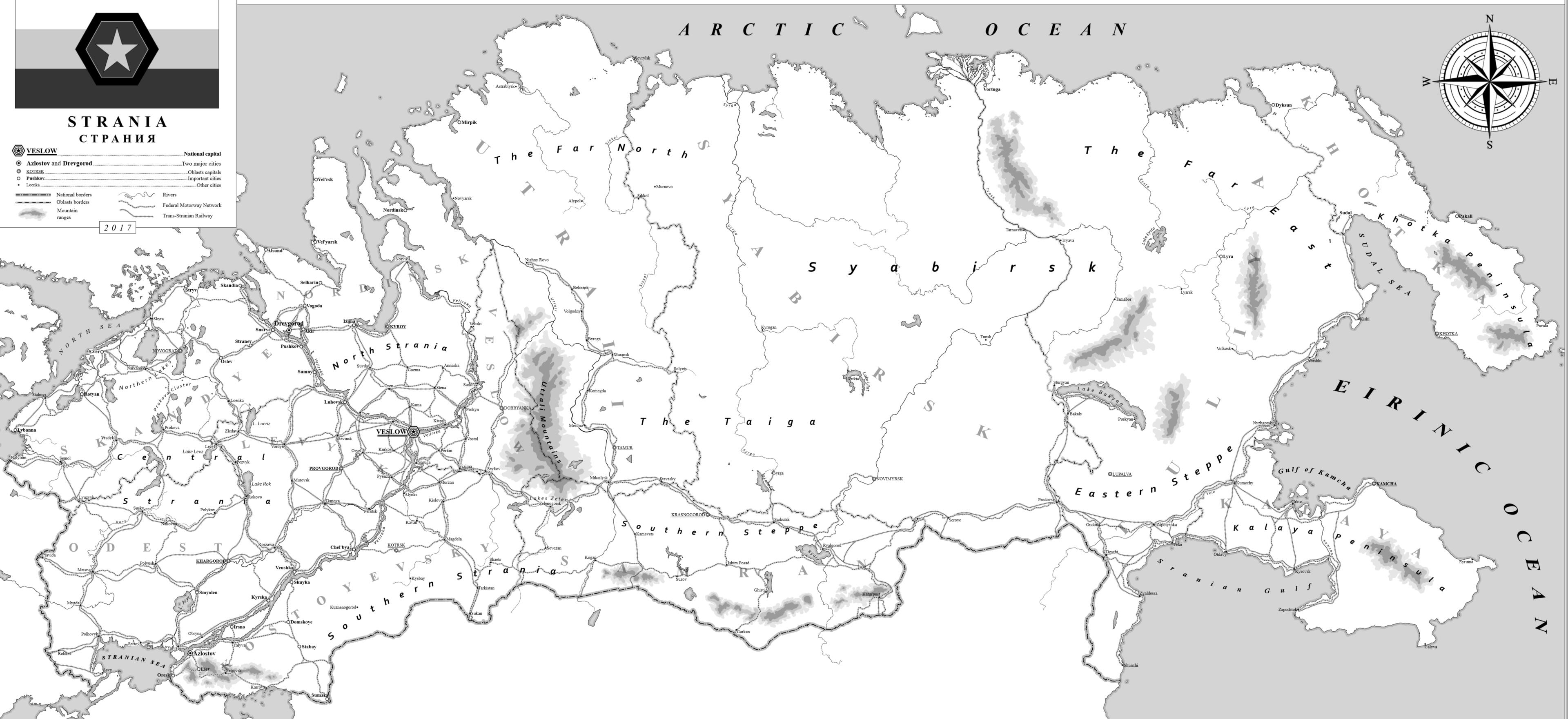
Map by Vonnettemapsalt - Vonnette
“Forward Strania!”
“God is with us!”Overview:
Strania (Страниа, Stran-e-ya), is a country spanning Eastern Eurathra and Northern Azhin. It is the largest country in the world, covering over 20 million square kilometers (7.7 million square miles), and encompassing more than one-eighth of Timina’s inhabited land area. With 10 time zones, and the most borders of any country. With a population of 170 million, making it the most populated country in Eurathras. Strania is the largest Stravic and Eurathean nation; they speak Stranian, the most spoken Stravic language, and the most spoken native language in Eurathra.
The sister cities:Veslow: Veslow (Veh-slow) is the capital and administrative center of Strania, located at the strategic confluence where the two branches of the Velireka River merge into a single, immense waterway. This junction has made Veslow the natural heart of Stranian civilization for centuries—economically, militarily, and culturally. The origins of Veslow date to the early Stran settlements along the lower Velireka. Positioned at the most navigable convergence of the river’s northern, western, and eastern branches, the site served as a crossroads for river trade, migration, and early state-building. Its location allowed the Stran to anchor their influence in all directions, enabling expansion into the Central Plains, the Utrali mountains, and the southern borderlands.
In the modern era, Veslow remains the largest and most populated city in Strania, with an extensive metropolitan area composed of hundreds of towns and satellite cities.Drevgorod: Drevgorod is the oldest continuously inhabited Stranian city, founded by Ulrik the Founder during the earliest river expeditions along the Velireka. Positioned at the northern bend of the Central Plains, it served as the first stable settlement of the Stran people. Drevgorod remains a major cultural and religious center, with several of the oldest Stranian-orthodox structures in existence.Azlostov: Situated southwest of the Criyeya Mountains, beside the Stranian sea, Azlostov forms the heart of Strania’s foreign trade network. Historically known for military shipworks and academies, early fortresses, and frontier communities, it acts as the naval junction between Strania and the western world. It is a major finacial capital along with Veslow, Drevgorod, and other cities situated along the Velireka.Three rings: Kieslow, being the most populated and important city in Strania, has many hundreds of towns and cities surrounding the local area. Some of the cities on the furthest, third ring can be over two-hundred km from the city of Veslow. Felons are prohibited from inhabiting Veslow, and as a result during the nineties, many of the large cities around Veslow became hubs for local criminal rings.The Veslow Kremadel: An ancient citadel located on the bank of the Velireka. Kremadels were ancient Stranian fortresses most often made in an ornate octagonal or hexagonal shape. These fortresses often served as the head of governance for the city and/or region. Kremadels fell out of favor during the Stranian Empire as palaces and courthouses slowly took the place of the Kremadel.
The Kremadel in Veslow has been the seat of Strania's government since 876, and houses the head of state and his family. This is the origin of the hexagonal symbol on the flag of the Stranian Civic Union, and the flag of the Stranian Federation.Federal Motorway Network: First proposed in 1953, the Federal Motorway Network is a series of motorways and high-speed highways built and maintained by the Stranian federal government. The motorways were built in response to the great patriotic war, with the motorways serving a secondary purpose as military logistical hubs. If required, most portions of the motorway can be made into an improvised runway with a few hours of construction.
These roads are noted as being higher quality than most of Strania’s road networks, and spans over 50,000km. Making it a significant portion of Strania’s total 1.30 million km roadway networks (paved and unpaved).
The maximum rated speed on federal motorways are 110 kph, while some express routes are rated for 135kph travel.Trans-Stranian Railway: The Trans-Stranian Railway (TSR) is the largest continuous rail system on Timina, running west–east for thousands of kilometers. The TSR operates both passenger and freight routes across the country. Railways were critical during the Patriotic War, when western industry was relocated behind the Utrali mountains in the face of Zloanian advances. The railways are continually expanded and maintained even into the modern day, with new high-speed routes being constructed to bring the century-old railway into the new age.Southern Steppe: The Southern Steppe forms a dry, rolling grassland zone extending east of the Criyeya Mountains for thousands of kilometers. Historically a zone of conflict and nomadic interaction.
The region remains well populated, with rail and road lines forming long, straight routes across the plains.Eastern Steppe: The Eastern Steppe stretches between the Syabirsk frontier and the far-eastern port cities. Its climate ranges from semi-arid grassland to cold desert. Historically it served as the route of early imperial expansions, caravan trails, and later the eastern military districts.The Far-east: The Far East comprises Strania’s easternmost region, including coastal mountains, the Pacific-facing ports, tundra forest transitions, and the eastern military bases watching over the Eirínic Ocean.
It is characterized by sparse settlements, fishing communities, cold maritime climate, rugged terrain, and dozens of unique ethnic groups and languages.Kalaya peninsula: The Kalaya Peninsula is a well-forested and mountainous coastal region with access to the Gulf of Kanova. Settlements are concentrated along its southern shoreline. Kalaya is known for mineral resources, fisheries, naval facilities, and maritime research bases.Khotka peninsula: North of Kalaya, Khotka is a harsher peninsula facing the Eirínic Ocean. It is known for tundra, cold winds, and rugged cliffs. Historically it was used for early warning over-the-horizon radar arrays, and resource extraction.North Strania: North Strania is the general region above Veslow, spanning East and West from Drevgorod. Within the territory lie the major cities of Kama, Izima, Kyrov, Norvik, Asund, and others. Most of this territory is contained within the Nordinsk oblast.The Far North: The Far North is one of Strania’s coldest region, facing the Arctic Ocean. Featuring permafrost, cliffside glaciers, and minimal permanent settlement, it is the ancient home of the Yugits people. Today much of the far-northern territory is an autonomous republic for the Yugits.Lake Bakyan: Lake Bakyan is the largest lake in the world, located in Southern Syabirsk. Its vast shoreline contains many native ethnic settlements and archaeological sites dating back over 3,000 years. Bakyan is also a major freshwater reserve and a significant location for freshwater fishing and agriculture.Rivers and lakes: Strania’s river systems include the Velireka itself, the Lyra, Eysta, Tunsk, Syrga, Sikkol, Danu, Utrali, and several smaller river systems. Rivers served as ancient trade routes, tribal borders, and industrial transport lines. Many towns and early settlements formed along these waterways.
While rail and road transport have significantly lessened the Stranians dependence on river based transportation, ferry services still remain common. During the times of the Stranian Civic Union, many state-operated river cruises traveled down the rivers Velireka, in the lake Aryl, and across other lakes and rivers.In the pre-industrial era, massive disposable ships made from logs called belyana would be sent downstream from major logging sites. These massive ships would be made of and carry tens of thousands of tons of raw logs and refined lumber, and were often decorated with steeples and miniature houses, often being called “floating cities’. These ships would be navigated to their resting place and disassembled for their resources. They are among the largest known wooden ships to ever be built, with the longest example measuring at 125 meters long.Another notable vessel is the Shitik. These are broad, flat-bottomed sewn boats used since the 10th century. With the shallow reefs of the Northern coastlines and shallow rivers, a flatter keel than traditional vessels was required. These boats were believed to be adapted from Velirekan vessels which navigated the deeper waters of the mighty river for centuries.The importance of these many rivers and lakes cannot be understated. Without them, the Strauvic peoples and countless others would never have inhabited the land now known as Strania.Central Strania: Central Strania contains the most arable land in the country. These plains stretch from the western foothills of the Utrali to the northern forests. This region hosts Veslow, and most of the Three Rings’ metropolitan development.
The plains remain the agricultural and demographic heart of the nation, hosting an overwhelming majority of Strania's population, despite her vast size.Southern Strania: Southern Strania borders the Criyeya Mountains and expands to Azlostov and the Southern steppe. Its climate ranges from continental to warm-steppe, and contains unusually fertile lands. Historically it served as a crossroad between Strania and Middle Eastern trade networks, and it's distance from Veslow along with it's
The region contains vineyards, orchards, and centuries-old fortresses.Syabirsk: Syabirsk forms the immense central-eastern expanse of Strania: cold, flat, sparsely populated, and covered with mixed taiga and tundra.
Syabirsk is known for it's bitter winters, it's resource extraction, and near-permanent permafrost in some northern regions. Despite the harsh, empty environment, several ethnic groups inhabit this region with their own autonomous republics.The great taiga: The Great Taiga spans a small belt from the southern tip of the Utrali eastwards. This region is dominated by dense evergreen forests and is one of the largest contiguous forest zones on earth. Besides the banks of the Velireka, the great Taiga is one of the oldest inhabited regions of modern-day Strania.Utrali Mountains: The Utrali Mountains (O-tral-iy), or simply the Utrali, are a mountain range in Strania that runs north–south, from the coast of the Arctic Ocean to the lakes zelen. The name Utrali is theorized to come from the ancient Stranian word for a stone, Utla, later coming to mean a cliff or crag. One of the older regional names for the mountains translates as “the belt of stone”. The Mountains began to be referred to by their modern name Utrali around the 18th century.
The mountain range forms the conventional boundary between the continents of Eurathras and Azhyr, marking the separation between Western Strania and Eastern Strania. The average altitudes of the Utrali are around 1,000–1,300 metres, the highest point reaching a height of 1,900 metres.
The mountains lie within the Utrali oblast. Their resources include metal ores, coal, precious and semi-precious stones. Since the 18th century, the mountains have contributed significantly to the mineral sector of the Stranian economy.
The region is one of the largest centers of metallurgy and heavy industry production in Strania. The mountains are notable for their role in Stranian defense. During the patrotic war, Stranian industry was moved beyond the Utrali mountains. This formed the “Utrali chain” of industrial cities, including Tamur, Mest’no, Muransk, Dobryanka, and others. All which continue to be hubs of industry into the modern day. Making the mountain range and Utrali oblast the heart of modern Stranian industry. Though recent efforts have seen the wide re-industrialization of central Strania.
Religion
WIP for part 2. Lore of the Stranian Orthodoxy is still being written.
Conepts & Customs
WIP for part 2. We are still finishing all the Customs that Stranians practice.
Major national holidays
New year's day - January 1stNew Year’s Day marks the turning of the calendar. Traditions are centered on family gatherings, shared meals, and reflections on the past years. At midnight, church bells are rung to much celebration. Long-distance travel is common as citizens travel to and from their home regions for the holidays. Fireworks displays, community or family feasts, gift-giving, and night watches are common occurrences on new-years as well.Women's day - March 10thWomen’s day recognizes the historical and modern role of women in Stranian society. Established shortly after the civil war, it honors female laborers, motherhood, scholarship, and equality. The holiday marked by widespread gift giving to women across Strania. Flowers are customary. While not the purpose of the holiday, the day is often a time of eloping or honeymooning for couples.Remembrance day - September 3rdRemembrance day is dedicated to mourning the dead of wars and national tragedies. Unlike Victory Day, it is not celebratory in any form. At dawn, a national minute of silence is held as flags are lowered to half-staff. Public entertainment is suspended for the day by demand of the ministry of communications. Churches, memorial halls, and cemeteries remain open, often staffed by volunteers and veterans.
The day honors soldiers, civilians, emergency workers, and unnamed victims alike. Family gatherings are typically held during this day, along with ancestor remembrance.Defender of the homeland day - February 25thDefender of the homeland day honors all those who serve or have served in Strania’s armed forces across history, including soldiers, reservists, civil defense personnel, and border guards. Similar to remembrance day, wreaths are laid at local memorials, and military units hold internal ceremonies. The head of state typically holds a pubic ceremony at the tomb of the unknown soldier in Veslow at the eternal flame.Victory day - April 10th.Celebrated since 1949, Victory day commemorates the ending of the Stranian-Zloanian war, also known as the Sacred War or Great Patriotic War. Victory day includes a military parade in Veslow hosted by the head of state, a grand fireworks display in the evening, and the running of public-alert sirens at 5:00AM. Similar celebration and commemerations take place in 'hero cities' that were host to important battles or events during the war.A part of victory day is the 'Immortal regiment'. In most every city and village, the ancestors of soldiers, public workers, emergency services, and civilians lost in the Patriotic War march holding banners, pictures, and relics of their deceased ancestors. This is done to immortalize the memory of the heroes who gave their lives in sacrifice for the homeland.
Victory day is one of the most sacred days in all Strania and is held with intense reverence and respect.Labour day - May 5thEstablished shortly after the civil war, labour day honors industrial workers, agriculture workers, farmers, engineers, and construction workers. The day also commemorates postwar reconstruction after the Patriotic War. The day is also used as a chance to advocate for workers rights and unions. The holiday has enjoyed less fervor after the end of the Stranian Civic Union, but still remains a national holiday today.Unity day - November 13thUnity Day commemorates the liberation of Strania from the R'han, however it also represents the end of the time of troubles, and more recently, the anarchy/ 1980's. The day emphasizes cohesion over regional rivalry, ideology, and factionalism, and was established on the same day that Georgy Orlovky banned all political parties from Strania. To this day, no party representatives are allowed to be submitted into office, only individual politicians.
Flag hoisting ceremonies are held in Veslow and other cities, as well as a public speech by the head of state and the broadcasting of the Stranian national anthem. The youngest national holiday, unity day is a representation of the forging of a new Stranian identity in the 21st century and onwards.
Festivals and rituals
Veslow sirens - September 3rd.Annually on September 3rd at 5:00AM, public-alert, air-raid, and warning sirens are ran in the cities of Veslow, Drevgorod, and Azlostov. This is typically followed by the entire population freezing in place on roads or at work. The sirens last for roughly 2-5 minutes. This annual ritual is to commemorate the beginning of the Great Patriotic war, as well as the attacks on Veslow, Drevgorod, Azlostov, and other cities during the war.Kupila niight - Mid JuneKupila night is celebrated on the shortest night of the year, typically around June 3rd-25th.Typical celebrations of Kupila include the lighting of bonfires along rivers of the edge of villages. Young people then leap across the flames for luck and fertility. Couples are also known to jump together to 'test their bonds'.
Other rituals include the making of flower wreaths or floating of wreaths on water. Or wooden wheels attached to poles are lit on fire, then spun. Fire is a central point of Kupila night, and several other ancient festivals. In orthodox communities the festival is tolerated but much restrained. Despite this, Kupila Night remains one of the most widely practiced folk traditions.UrzhoykestAn annual harvest-festival practiced in medieval and early Strania. Some rural villages continue to celebrate the harvest season with feasts and celebrations. Communal feasts are held with breads, grain porridges, and preserved meats, along with alcohol. Tools are cleaned and repaired while the village's grain stores are emptied. These stores were often kept in surplus to be used by poorer members of the community and in times of famine.
In medieval Strania, the Urzhoykest served as both festival and census as deaths, births, and food stores were declared publicy. Today, the celebration survives mainly in rural regions and villages.VelykalaVelykala is a pagan river festival dedicated to the Velireka and predates written history, being practiced by the earliest Stranians. Offerings of bread, salt, and flowers are cast into the river and it's Tributaries, while small boats and rafts are decorated with ribbons and greenery, and then sent downstream. The orthodox church later absorbed the festival, with crosses being dipped into the current and blessed water from the Velireka holding a sacred importance.
Cuisine
Breakfast & Comfort Foods
Drakniki
Grated potato pancakes fried in oil or butter. Crisp outside, soft inside. Traditionally topped with smetana or mushroom cream.Syrniki
Sweet or lightly savory patties made from tvorog, flour, and egg. Fried until golden and served with honey or varenye.Blini
Thin fermented pancakes, historically eaten during festivals. Filled with cheese, caviar, mushrooms, berries, or ground meats.Kotleti
Bread-softened ground meat patties seasoned with onion and herbs. Served with mashed potatoes or buckwheat porridge.Grenki
Fried or toasted slices of stale bread, often rubbed with garlic or dipped in egg. Breakfast or a snack alongside tea.Oladyi
Small, thick yeast-based pancakes. Softer and fluffier than blini. Often eaten with jam, sugar, or sweetened tvorog.Toppings & Condiments
Smetana
The essential Stranian sour cream. Added to soups, stews, pancakes, or eaten on its own with bread.Tvorog
Soft farmer’s cheese used in pastries, breakfast dishes, and cottage-cheese desserts. One of the oldest dairy products in Strania.Caviar
Harvested from northern rivers. Used sparingly as a garnish on blini or bread. Traditionally a celebration food.Varenye
Whole-fruit preserves. Fruits are cooked gently in syrup, keeping their shape. Served with tea, porridge, or pastries.Soups, Stews, Porridges & Salads
Olivier Salad
Cold, creamy salad made with potato, egg, pickles, sausage, and peas. Extremely common during holidays and state celebrations.Solyanka / Rassolnik
Solyanka- thick, salty soup made with brine, pickled vegetables and assorted meats or fish.
Rassolnik- Soup made from a lighter brine broth than solyanka, with barley, kidneys, or other meats.
Both soups are considered restorative, and/or hangover cures.Kasha
Boiled grains, usually buckwheat or barley. Served savory with butter or sweet with honey. A foundational Stranian dish.Borscht
Beet-based soup with cabbage and meat broth. Served hot with smetana. More common in southern regions and borderlands.Okroshka
Cold kvass- or kefir-based soup with chopped vegetables and sausage. A summer staple.Shchi
Cabbage soup prepared either fresh or using fermented cabbage (sour shchi). Known as a “poor man’s soup,” eaten across all classes.Zharkóye
Stew of beef, potatoes, and carrots, slow-baked in ovens. Served during winter months.Ukha
Light, clear fish broth. In northern Strania, often drunk like tea during hunting or ice-fishing trips.Vinegret
Beet salad mixed with potato, carrot, pickles, and oil. Often bright purple and served as a cold side dish.Mimosa Salad
Layered fish-and-egg salad with grated cheese and mayonnaise. Common at state banquets.Dressed Herring
Layered salad of herring, beet, potato, carrots, and mayonnaise. Traditional for winter holidays.Main Dishes & Meats
Kielbasa
Sausage varieties ranging from smoked to boiled. Pork, beef, and mixed-meat versions exist.Pelmeni
Small dumplings filled with seasoned meats. Boiled and served with butter, smetana, or vinegar.Pierogi
Stuffed dough pockets, either savory (potato, cabbage, mushroom) or sweet (fruit fillings). Usually fried or boiled.Shashlik
Meat skewers grilled over wood embers or charcoal. Very popular in southern oblasts.Piroshki & Potato Piroshki
Golden fried or baked dough with fillings. Fillings include potato, egg, cabbage, or minced meat.Stroganoff
Sautéed beef in creamy mushroom sauce. Served over noodles or rice. Common in urban restaurants.Shwarma
Stranian adaptation of Levantine wraps. A widespread street food.Golubtsy
Cabbage leaves wrapped around minced meat and rice. Cooked in tomato or cream sauce.Nyanka
Ancient dish made from sheep offal and brains mixed with onion, stuffed inside the stomach, and boiled. Rarely eaten today except in remote pastoral communities.Kholodets
Meat jelly made from slow-boiled bones and meats. Served cold. Considered divisive in it's texture and taste.Tushonka
Canned stewed meat with its own jelly and lard. Shelf-stable and widely used by soldiers, hikers, and rural households. Culturally equivalent to Western “spam.”Stroganina
Long, thin frozen slices of northern freshwater fish eaten raw. Originated among the peoples of Syabirsk and the Far North. A Drevgorod restaurant is known for popularizing gourmet versions.Doctor’s Sausage
Mild, finely-ground sausage originally produced for health diets. Now a staple of school lunches and sandwiches.Pozharsky Cutlet
Chicken cutlet coated in breadcrumbs and fried until crisp. Juicy interior achieved by mixing butter into the meat.Desserts & Dairy
Kefir
Fermented milk drink used for breakfast or light meals. Known for digestive benefits.Nalesniki
Thin rolled pancakes filled with sweet cheese, jam, or poppy seed paste.Chak-chak
Honey-glazed fried dough pieces pressed into bars.Sushki
Hard, ring-shaped bread snacks served with tea and often softened by dipping into steaming tea.Rogaliki (Rugelach)
Small crescent pastries with jam or nut fillings.Sharlotka
Simple apple sponge cake, quick to prepare and found in most households.Vatrushka
Round pastry with a center of sweetened tvorog.Kissel
A thickened fruit dessert or drink made from berry juice and starch.Zefir
Soft whipped confection flavored with apple or berry purée. Similar to marshmallow but lighter.Sweet Kasha / Guryev Porridge
Cream-based semolina porridge layered with nuts and caramel.Pryanik
Spiced cakes or cookies decorated with intricate patterns. Often molded using carved wooden stamps.Pastila
Pressed fruit purée confection, historically made with apples from central orchards.Verhuny
Twisted fried pastries dusted with sugar.Bread Pudding / Charlotte Cake
Desserts made from leftover bread mixed with milk, fruit, and sugar, then baked.Ptasie Mleczko
Soft marshmallow-like sweets covered in chocolate. Common gift or holiday treat.Drinks
Kvass
Lightly fermented rye beverage. Non-alcoholic by law in most regions. Served cold, most often during the summer.Krupnik
Honey-infused vodka or spirit. Traditionally consumed in winter or used in toasts.Vodka
Clear grain distillate with a long Stranian history. Modern Stranians drink less alcohol per capita than Eserikans, contrary to stereotypes.
Historically vodka was used to sanitize water or as medicine. It also is used an informal manner of trade or payment, alongside cigarettes and similar goods.Medovukha
Fast-fermented honey drink, ancestral to the Stran people. Similar to mead but with a faster fermentation. Medovukha was the first major trade commodity in early Stranian history.Zhigulevskoye
A state-produced pale lager. Universally available. Opinions vary from beloved to begrudgingly tolerated. Flavor is mildly bitter with light hop notes.Tarasun
A strong distilled drink made from fermented mare’s milk. Cultural centerpiece of the Buretz peoples of Syabirsk. Used in rituals and ceremonies.Baked Milk
Milk slowly caramelized to a beige color. Used by itself or cultured into varenets, a thick dairy product.Kompot & Mors
Fruit drinks made from boiling berries or stone fruits. Sometimes mixed with vodka to make simple cocktails.Tea
The cornerstone of Stranian beverage culture. Served in glasses with metal holders called podstakannik or from boiling vessled called samovars. Despite western stereotypes, tea is more popular in Strania than alcohol, and has been for a century.
History of StraniaBNM (Before new millenia)~2500 BNM : Hunter-gatherer groups spread across what is now Central and Eastern Strania, establishing small seasonal camps. Some head northwards to form the Nordinskiy tribes.~1000 BNM : The first primitive carvings and tools appear near modern Drevgorod, representing proto-Strauvic culture. Archeological sites reveal much about their cultures.~800 BNM : The Nordinskiy tribes adapt to cold climates and develop basic metallurgy, marking the beginning of their Bronze Age. Knowledge spreads southwards to the other peoples groups.Earliest history520 : First description of early-Strauvic peoples by ancient Rumenos scholars. These peoples are believed to have inhabited what is now modern Kusdanlange and Central-Strania before expanding outwards.
“These men are of ruddy skin and blue eyes. Their hair is long and they wear great beards. Their hair is neither dark nor light and they are tall and strong in stature.”
620: Strauvic tribes begin migrating to the north-east and south-west from the North Sea to the Medthranian ocean. As noted by Gregov II in the Rumenos empire.
“I am both distressed and disturbed by the arrival of the Strauvs, who appear on your borders in great numbers. The grass no longer grows where they march as are their size. I am disturbed as they may begin to enter Imentia soon.”600-700’s : The Strauvic peoples settle in place after the great migration and begin to form permanent tribes. Notable groups include the Strangian tribes, the Vendneti tribes, and the Sclaventi tribes. The Strangian tribes are located in the Eastern lands around the Velireka while the Sclaventi and Vendneti settle West-wards. This begins the divide between the East, South, and Western Strauvs as distinct subgroups of the Strauvic peoples.During this time, Northern vikings interacted with these Strauvic tribes. The Velireka becomes a busy riverway for these northmen, whom name the river the Velys. Some begin to trade with the tribes for furs and grain. Others took Strauvic slaves to sell in further southern lands.
784: First references to the “Volchitsya” or the she-wolf. A single woman who transforms into the form of a wolf, cursed to walk the earth forever. Myths and legends about this Volchitsya continue on for centuries, prompting similar beliefs of shapeshifters to spread among the Strauvic tribes.The Ulrikid dynasty
856 : Viking nobleman Ulrik sails down the Velireka and establishes three settlements along his way before returning to Norland. These settlements are Dre’evum, Aslo, and Vesla.
857: Several Strauvic tribes war against viking settlers. "The men who wander (Stran) drove the Northmen back beyond the sea, refused to pay them tribute, and set out to govern themselves."
Shortly after this victory, these tribes begin to infight and war against one another brutally.
860: Ulrik is called to his settlements to bring order back to the land. With his two sons and a large retinue, Ulrik takes his seat in Dre’evum and rules over the city. Shortly after, the territories of Vesla are consolidated under his rulership.
“They said to themselves, "Let us seek a prince who may rule over us and judge us according to the Law." They accordingly went overseas to the Norland. The Strangians, the Slienains, the Krivyachians, and the Velys' then said to the people of North', "Our land is great and rich, but there is no order in it. Come to rule and reign over us.".
860-874 : Ulrik’s reign introduces a formalized runic script to the Stranian peoples, who previously had no known written language.
874: On his deathbed, Prince Ulrik hands power to his son Ulrimyr, beginning the Ulrikid dynasty.
(Note : In this early formational period of Strania’s history, many hundreds of background events co-encide with the rise of the Ulrikid dynasty and the Knyazes and princes of the period. Trickery, subjugation of independent cities and tribes, trade negotiations, and similar events often occurred.)
876 : After crushing a rebellion in the Vesla, Ulrimyr moves the capital to the city and names himself “Prince of the Stran.”, or the Knyaz. Aslo’s territories are consolidated under his rule to protect from Kazyn incursions. Ulrimyr ultimately forms the first Druzhina. This is a retinue of soldiers, bodyguards, and assistants of a Knyaz who always accompany him.
892: Ulrimyr passes and passes rulership to Sviatomyr I, known as ‘The wise”, who further lays the foundations to an organized Stranian state by further centralizing power.
974 : Missionaries from various faiths attempt to convert Saint Vasily rejects their faiths but takes interest in southern orthodoxy. He begins a process of conversion of the Stranians into a ‘new orthodoxy’, later becoming the Stranian orthodoxy. Relations improve slightly with western neighbours, particularly Byantivia.
980 : Vasily’s powerful rulership leads to the beginning of a Golden Age of the Stranian state. The older Stranian runic script is slowly replaced with the new Stryllic script, in order to formalize the script and letterings. Relations and diplomacy with foreign nations slowly improve with the easier to understand and westernized script.
992 : Vendneti tribes bordering the Stran’s Western border integrate with the local populations and form who are now known as the Kusdan.
1st Millennium
1000 : Strania expands over 1,29 million square kilometers with 5,4 million people.
1011: Saint Valisy I passes and Vasilopolk I takes rulership of Strania.
1016 : Vasilopolk I issues the first legal code in the Strauvic world, replacing the older ‘ryand’ code of law. An orally passed legal and codal system used since before Ulrik came to power.
1018: Sviatomyr II overthrows Vasilopolk I and takes the throne of Vesla as Knyaz.
1020 : Vasilipolk I reclaims the throne in Vesla.
1021: Sviatomyr II once again retakes the throne in Vesla.
1052 : Sviatomyr II dies. The end of the Stran’s golden age begins as the state quickly loses influence and power over the coming years. The state becomes increasingly fractured with more and more polities ruling as independent provinces as the Knyaz continues to lose power.
1092 : A skirmish between the Ulrikid dynasty and Takar nomads turns into carnage with hundreds of Stranian deaths. Power in the southern regions of Strania wanes further.
1117: The “Primary Chronicle” is written by an unknown monk. It chronicles the history and formation of the Stranians and the dynasty of the Ulrikids.
1125 : The territories of Dre’evum and Novograd become autonomous, founding the Drevgradian republic that grows to become a powerful mercantile nation-state controlling much of the northern coastline.
1136 : First written record of Vesla being referred to as Veslow. From 1136 onwards the city is increasingly referred to as Veslow.The deeds of Volodymr the great.1233 : Saint Volodymr of Roman is born in the small town of Kyrov in Northern Strania to a local Knyaz.
1238 : The R’han horde pass underneath the Utrali mountains as they advance westwards. The cites of Zelen (Later Zelenogorsk) and Sevkov are besieged and overran and their populations slaughtered. Refugees fleeing west spread the word but infighting between Knyazes and princedoms prevents an effective defense of Central Strania.
1240 : In only three years the horde of the R’han lead by the Great Khan Khazumn defeats the local principalities of Strania one by one and burns Veslow and Azlo to the ground. The Drevgradian republic remains free after repulsing a much weakened R’han probing force.
1241 : What remains of the Stranian Knyaz offers a regular tribute of silver, slaves, and goods to the R’han and survives as nothing more than a vassal. Strania becomes a scattered collection of tributary principalities and cities.
1243 : The Knyaz of Tulya takes advantage of the absence of the R’han Commandery to declare itself free.
1244 : The same man is emasculated then beheaded by the R’han Commander upon his return. His family and lineage is executed similarly.
1252 : The tiny towns of Nordin, Vel’yarsk, and Novyarsk proclaim themselves as the sovereign state of Nordinsk.
1255 : Volodymr is taken captive by the R’han as a tribute noble. He is sent south and begins to learn the R’han language, military tactics, and customs.
1262 : Volodymr escapes captivity with a handful of followers, crossing back into Strania by crossing the Utrali. At the base of the mountain at a ruined shrine to Ulrik, he swears an oath to end the yoke of the R’han or die trying.
1264 : Volodymr allies with the Nordinsk after a year of negotiations. Guerilla attacks become a regular occurrence.
1265: Creation of a brief confederation between Lybanna, Rotyan, Kalylnin, and five other cities in the west after the R’han leave due to logistical strains.
1272 : A punitive expedition for Volodymr’s attacks is launched northwards by the R’han. Stena, Annaska, Kyrov and Veliski are crushed. Volodymr leads the battle in the pines, defeating a larger R’han cavalry force in the forests south of Norvik. Ropes are tied between trees and pitfalls are one of many tactics used, inspired by Volodymr’s years of guerilla training and knowledge of R’han tactics.
1273 : Norvik is raised to the ground in retaliation, but most of the population was evacuated prior due to interception of R’hans communication convoys. A counterattack to surround the R’han garrison ends in a pyrric victory for the Stranians.
1275 : The local victories have fully earned the trust of the Nordinsk, who name Volodymr Knayz. The cities of Kyrov and Veliski join the coalition.
1276 : The Drevgradian republic joins the coalition, giving Volodymr nigh unlimited funds for mercenaries and weaponry. The resistance becomes a standing army.
1277 : Khan Khazumn launches a counterattack of 20,000 men Northwards towards the Nordinsk and the Drevgradian republic. Coalition forces pull back across both ends of the Velireka.
1278 : The Nordinsk lead a successful defense against the R’han at the battle of the Velireka. On the outskirts of Veliski the R’han stage a feign retreat (a common tactic to draw out and flank attackers). The Stranians break the Velireka behind the R’han and launch attacks from the North and South, flanking the army. While phyrric, the 10,000 strong R’han force is defeated and is forced to retreat with more than 5,000 dead. Drevgorod’s resistance failed, and the ancient city is raised. Every building is destroyed and the population of the city and its surrounding territories are tortured and executed. In response Volodymr writes the lament of Dre’evum.
1281 : Volodymr leads a guerilla campaign around the ruined Drevgorod. The destruction of the city and the story of Veliski’s resistance leads to numerous peasant revolts across Strania. Volodymr begins to spread trusted commanders to organize local resistances into resistance cells across the R’hans territory.
1286 : The Kusdan to the West join in Strania’s resistance, providing men and security to the west. Volodymr begins a crusade to retake all of Strania west of the Velireka. Southern Kazars begin to fight against the R’han as well, with war-wagons being used to great effect.
1288 : The battle of Sumny. Five-thousand R’han meet Volodymr’s forces west of Sumny. A local river off the Velireka is diverted to turn the battlefield into a marsh. The coalition wins against the R’han with superior tactics and terrain knowledge. The local chieftain is captured and executed publicly. Liaisons to the R’han khanate announce open war—they are not seen again.
1289 : A R’han general named Ghita defects to Volodymr under threat of execution by Khan Kazhumn.
1291 : News of Volodymr’s successes inspires further revolt. Retaliatory attacks only serve to embolden the growing resistance. Ghita’s knowledge of the R’hans weaknesses leads to increasingly common partisan attacks against supply lines and couriers.
1294 : Khan Kazhumn dies as the R’han infight for the position of Khan. Volodymr takes advantage of the chaos and reclaims much of Central Strania and of Veslow. He is crowned Great Knyaz of all Strania and refounds the Stranian state against the Khanate.
1301 : Azlo is regained and renamed Azlostov by Volodymr. All territories west and north of the velireka are regained by the Stranians.
1303 : After recovering strength, Volodymr leads an offensive against the R’han. The Stranians regain all the territories of the southland from Veslow to the Criyeya mountains. The battle of the lakes Zelen ends in a Stranian victory, restoring her former borders.
1305 : Volodymr establishes the Stranian empire, declaring that no invaders may rule over the Stranian peoples again. He is crowned as Tsar of all Strania within a cathedral in Veslow, ending centuries of infighting by Stranians.
1307 : Volodymr leads the scouring of the R’han, expanding eastwards into R’han territory. The much weakened horde collapses over the course of years of conflict while the Stranian lands expand. Any peoples identifying as R’han are put to the sword without mercy. The expansion ends at the Tunsk river after the local khanate is repelled. An uneasy truce is declared between Volodymr and the remaining three khanates east of the Tunsk.
1317 : Volodymr dies at eighty-four. Post-humerously, he is declared a saint by the church and his deeds are immortalized.The Time of Troubles1318 : Volodymr II takes his father’s throne. His reign saw the uniting of the remaining independent states back into Strania.
1338 : Boris I becomes the Tsar of all Strania after Volodymr II’s death.
1346 : Boris I dies, leaving his intelectually-lame and immature son Boris II to rule Strania.
1359 : Boris II dies with no heir, ending the Ulrikid dynasty in the throne. Infighting by noble boyars ensues. The following decades are characterized by violent conflicts between boyar lines and lawlessness caused by the succession crisis. Numerous false-Volodymyr’s appear, claiming to be Volodymr III.
1376 : Polyeza crusaders invade Strania and Kusdanlangde, marching as far as Sevinsk before being repulsed.
1378 : In the face of invasion, Fyodorov II is crowned as Tsar, ending the succession crisis. The crisis leaves over 1 million Stranians dead and wide swaths of farmland barren.
1390 : Fyodorov II dies with no heir. To avoid another time of troubles, his spouse Anna is elected as Tsarina.
1391 : Following revolts by boyars, Anna launches a purge of many boyar nobles with military officers loyal to her rule. Her reign is seen as a second golden age of Strania.13-19th century1397 : Anna ratifies the law to allow Tsars to assign successors not related by blood.
1420 : On her deathbed, Anna passes rulership to Mikhail I.
1487 : Veslow riots due to excessive salt taxation.1532 : Kotrsk is plundered by southern Takars from the Criyeya mountains.
1537 : A brutal reprisal against the Takars ensues, capturing territories past the Criyeya.
1565 : War against the Khanates of the R’han in the vast eastern steppes results in a Stranian victory. Strania takes the Eastern Steppe and Kalaya peninsula.
1576 : Birth of the concept of "Eternal Strania"
1587 : A mountain in South Eser erupts, discharging enormous quantities of sulfur and ash into the atmosphere. The world experiences a volcanic winter leading to crop failure and a famine in Strania that kills 1/4th of the population.1602 : First matchlock rifles imported by the nobility of Drevgorod.
1614 : A new series of codified laws are established in Strania, known as “The Statutes of Kusdan”
1629 : Kozar uprising in Stabay the Volta that ends in severe humiliation for Strania.
1659 : A military alliance and mutual-defense pact is formed between Kusdanlangde and Strania, formalizing decades of favorable relations into an official alliance.
1683 : Invention of the movable copper-plate printing press by a Stranian polymath.
1689 : The alliance between Kusdanlangde and Strania is renewed.
1701 : Formal beginning of the reign of King Pyotr IV of Strania, called the Consolidator.
1702 : The Gryvne (A unit of weight/currency of silver often appearing as individual 205 gram “rods”.) is replaced with the Imperial Ryvnie. Strania becomes the first country to adopt decimal currency. With a single silver Ryvnie equalling 100 copper denka.
1711 : First complete topographical map of all Strania made by the Academy of St. Lorena.
1722 : Founding of the first Imperial Arsenal in Saruga for the casting of bronze cannons.
1726 : Opening of the Azlostov shipyards, the future heart of the southern fleet.
1739 : First city duma is established in Veslow. Dumas appear later in Drevgorod and Azlostov before expanding to most cities.
1743 : All of Syabirsk and the far-east have been explored and settled by Stranian expeditions. A new map of Strania is commissioned by the Tsardom.
1754 : Establishment of a state monopoly on Salt, and thus a new source of revenue for the imperial treasury.
1785 : Sedunwe launches a land-invasion of Strania near the Northern lakes. Polyeza later joins in the war, fighting against Kusdanlangde. The invasion is thwarted a year later.
1798 : Dauvi steam engines used for mine drainage are first discovered by Stranian merchants. Dauvi engineers and polymaths are brought on a diplomatic mission to Veslow where they share their designs, theories, and discoveries.1807 : A mechanized silk-mill in Krasnogorod proves the benefits of industrialized factories.
1809 : A coalition of Thorce, Sedunwe, and Polyez Marches into Strania through The kingdom of Zloania. The invasion lasts nine months and reaches as far as Kurkov before retreating. Stranian scorched-earth tactics and partisan activities combined with an unusually cold winter leads to a crippling defeat for the coalition that dissolves immediately after. Industrialization of Strania is slowed as the nation recovers.
1825 : The first Stranian steam locomotive is constructed by the Verpanov brothers after years of experimentation with mine-drainage engines. This locomotive was proven to move 3 tons of cargo at 15kph on a 900 meter section of track. Noblemen bring news of the invention to the Tsar of Strania who takes great interest.
1826 : The Tsardom purchases a patent for hot-blast steel production from Veylantia. An imperial steel-mill is opened in the outskirts of Veslow. The new steel is regarded as much higher quality than previous types produced within Strania. More steel mills are opened in the following years.
1829 : The first 25 kilometers of railway track are laid in Strania. A standard track size of 1.6 meters is established.
1832 : The “Great game” begins, with foreign powers undermining Stranian influence in nearby nations.
1843 : The Kusdanlangde-Stranian railway route is completed, connecting the two countries across several thousand miles of track. Soon after propositions of a railway route spanning all of Strania east-to-west are proposed.
1852 : The Veslow technological institute is founded to further harness the power of the steam engine.
1857 : The Allamon empire and Strania declare war on one another. Strania declares itself the defender of Strauvic nations in the south. Thorce, seeking to regain former glory, aids the Allamons. Polyeza, Imentia, and Veylantia all form an anti-Stranian coalition, fearing growing Stranian influence in the west. Grécia and Kusdanlange ally with Strania in the conflict.
1860 : The conflict ends in a stalemate and is later known as the three-years war, or Stranian-Allamon war.
1865 : Strania produces 300,000 tons of steel annually. Industrialization continues throughout the century.
1870 : An imperial decree drastically limits the working hours of children under 14.
1872 : Work on the Trans-Stranian railway begins. It is designed to span from Drevgorod to Krasnogorod.
1874 : Young girls are allowed access to higher education institutions.
1882 : An imperial decree banned the employment of children under 14 in mines and factories.The Stranian civil war.1904 : The Trans-Stranian railway route is completed, spanning north-to-south along the cities of Drevgorod, Veslow, and Azlostov, before continuing eastwards to Velai. Further expansions over the years would connect to Kamcha in 1914 and to Sudal in 1928.
1906 : Founding of the Peoples Communist Party, with immediate total banning by Tasr Alexi I.
1909 : Sefar Ghita, a Stranian aristocrat of the Ghita lineage befriends the family of Tsar Alexi Ist and eventually becomes imperial advisor to both Tsar Alexi I and his son Alexi II.
1912 : Strania’s population reaches over 145,000.
1915 : Tsar Alexi I dies suddenly, leaving his nineteen year old son Alexi II to rule the Stranian Empire.
1916: Despite Field Marshall Alexander Zhayev’s advice, Tsar Alexi II reduces Strania’s standing army to 500,000. This act is courted and encouraged by imperial advisor Sefar Ghita.
Internationally, the Great Eurathean war begins with Strania’s ally Shyordia entering the conflict.
1917 : Mobilization against the Great Eurathean War and rapid growth of the military industry. The kingdom of Zloania is defeated by the Stranians at great cost. Indirectly leading to the future formation of the Zloanian Socialist Republic. After the war, many field armies are sent Eastwards to protect the border under the direction of Tsar Alexi II under the council of Sefar Ghita.
1918 : Sefar Ghita personally executes Tsar Alexi II and initiates a coup of the imperial throne. Strania descends into chaos and uprisings as various political factions vie for power across Strania.
1919: Upon learning of a coup, Field marshall Alexander Zhayev of the 5th army takes the Trans-Stranian railway back to the capital to reclaim the throne. Foreign powers begin to ‘intervene’ in the civil war, trying to gain land and influence within Strania. The Nyoanese empire launches a land invasion in the east and captures kalaya and Ondon.
1922: After a long civil war, Alexander Zhayev retakes the capital of Veslow and the Kremdel citadel. Sefar Ghita and his allies are executed by Alexander Zhayev once the Tsar is found to be dead. With no heir to the throne, bickering among noble houses and political parties begin. Alexander Zhayev refuses to rule Strania. Ultimately the Stranian Civic Union is formed the next year, initiating the end of the Stranian Empire. Alexander Zhayev and many soldiers of the 5th army retire in protest. 1922 is later known as “The year of uncertainty.”
1923: Trial and purges of Sefar Ghita’s loyalists and collaborators begin in the new Stranian government. The east is recaptured in a pyrrhic war against the Nyoanese empire that sees the disorganized southern fleet destroyed.
1925 : Massive expansion of the trans-Stranian national railway network begins.
1926 : Famine caused by global economic depression, Stranian civil war, and uncertainty and mismanagement of the new Stranian government. Education also becomes compulsory education until age 16 and mass literacy.
1927 : Formation of the first state-ran collective farms, or sovkhozes. Bill for total agricultural collectivization fails in the federal duma, citing the failures of the Zloanian Socialist Republic’s (ZSR) agriculture campaigns.
1929 : The Zloanian Socialist Republic is formed on the western border of Strania.
1930 : Creation of the Saratovia Academy of Sciences with physicist Arkadin Lomonosov. The Zloanian Socialist Republic begins its five-year industrialisation and militarization plan.
1932: Formalization of a new constitution to replace the 1922 constitution.
1937 :Non-aggression pact is signed with the Zloanian Socialist Republic, with little trust. The decision is unpopular as Zloanian continues anti-Stranian propaganda campaigns and further radicalizes. Later in the year, Stranian intelligence report buildups in Zloanian military forces on the border. This is ignored by autocrat Markarin.The Great Patriotic War/ The Sacred War.1938 : The Zloaninan Socialist Republic launches a surprise invasion on Strania with no declaration of war.
1939 : The siege of Novograd begins. Civilian evacuations take place as Stranian defenders hold the city for a year.
1940 : Following the weakness of the previous autocrat Makarin, Vagarin "The vengeful" Avdeyev launches a coup and assumes control of Strania. A concentrated defense-in-depth is organized after staggering losses in the previous two years. Total war begins in Strania as enemy tanks and infantry push into the heartland of central Strania. Factories, civilians, and industry are evacuated east beyond the Utrali mountains.
1941 : The Zloanians push to the river Velireka and besiege the capital city of Veslow.
“We witness now, the greatest trial our noble people have ever had to face. The enemy is once again at the gates of the ancient city. No longer have the foreign invaders come for conquest, but now, extermination. We must all stand against the invader as we have before. There is no surrender, for only death awaits us. For the sake of all Strania, Veslow must survive.” -Vagarin Avdeyev.
1942 : After a year long siege, the Zloanians are repelled and pushed 30km from the banks of the Velireka. Two million Stranian lives are lost in the battle for Veslow alone.
1943 : Slowly, Strania takes back occupied territories from the Zloanians. Dramatic battles are seen at Provgorod, Luhovsk, Pyenza, and Stranev.
1945: After a year of preparation, Grand Marshall Vladislav Kharbarov and Vagarin Avdeyev initiates operation Kostoyev. Three million Stranian soldiers meet five million Zloanians.
1946 : After a sweeping offensive, the Zloanians are pushed back to the border of Zloania. A vengeful Strania continues the offensive with fresh reinforcements and rotated units. After a year, the offensive slows to a halt.
1947 : Five million Stranian soldiers advance past the Zloanian border as town after town burns. Occupied Küsdanlangde is freed with the help of the Küsdan resistance.
1948 : The final battle over the capital of Prusha begins. Zloanian dictator Sefar Ghita is found dead. Victory is declared April 10th 1948.
1949 : 75,000 Stranian cities and villages are left destroyed as ruins and cinders. 30 million Stranian lives are lost in the fighting. Most of the deaths are civilians. The territories of Zloania are given to Küsdanlangde, forming a barrier between Strania and Eurathras.1950-19861950 : Adoption of a five-year reconstruction plan targets to re-house millions of Stranians. Zloanian forced-labor is used to aid in infrastructure repairs and reconstruction in Eastern territories and in Küsdanlangde. The Stranian economy faces a crash as the war-economy grinds to a halt.
1951 : Relations with Éseriká sour significantly over the perceived “iron curtain” of Küsdanlangde, the treatment of Zloanian civilians, and Strania’s refusal to pay lend-lease debts. An official “De-radicalization” plan is enacted, seeking to eliminate Zloanian culture.
1953 : The Federal Motorway Network begins construction. Intended for military use in war, the motorway is of significantly higher quality than most roads before it, using modern techniques.
1955 : The five-year reconstruction plan ends, with 8 million apartment blocks and houses being built. A second reconstruction plan begins to further recover and modernize Strania.
1957 : Strania launches the first artificial satellite named Pistnik after several failures.
1959 : First suborbital flight of a cosmonaut. Nikolai Papov becomes the first human in space.
1960 : A third five-year plan begins, focused on the production of consumer goods.
1962 : A military standoff with Polmavia occurs at the border of Küsdanlangde. Upon request, trania mobilizes and stations soldiers in Küsdanlangde.
1965 : Continued rearmament of Strania sees the development of new tank and ballistic missile programs.
1967 : Research into the automated Information system (AIS) program begins with the objective to create a statewide information network for economical and reconstruction purposes.
1968 : Military intervention in Küsdanlangde sees an attempted pro-western coup thwarted. Total war is averted with the west as negotiations succeed.
1969 : Commissioning of the first domestic mainframe computer begins.
1970 : Demonstrations in Veslow against censorship are met by repression.
1971 : Signing of a chemical weapons non-proliferation agreement with the West.
1972 : Kosmos-7 preforms a lunar landing the same day as Eserika. Strania and Eserika dispute who landed first.
1974 : Economic reforms based on furthering collective self-management begin.
1975 : Decree on environmental protection sees over twenty nature reserves created.
1977 : Color television is introduced nationwide on all six official channels.
1981 : Renewed tensions with the western powers over long-range anti-ship missiles.
1983 : The downing of a civilian flight causes a diplomatic crisis with western powers.
1986 : A partial default on sovereign debt due to western pressures causes a massive devaluation of the Ryvnie. A brutal economic crisis begins in Strania.The anarchy1987 : Controversial election of Relsynov with the support of private media. Campaign promises include ending the financial crisis and improving living conditions. It is later known that Relsynov’s funding is from western accounts.
1989 : Relsynov begins a coup of the Stranian Civic Union and begins signing reforms without the authorization of the federal duma. An attempt by Union loyalists to overthrow Relsynov fails and the federal duma is shelled by the military under Relsynov’s orders. It is noted many members of the Relsynov loyalists forces are of western descent and not Stranian. The Stranian Civic Union is disbanded by Relsynov and replaced with the Stranian Federation. The following period of time comes to be known as the anarchy.
1990 : In the face of economic uncertainty due to rapid privatization by Relsynov, millions of Stranians are forced into abject poverty. Starvation, criminal warlords, drug use, and crime become rampant, every-day occurrences across Strania. The privatization of Strania's economy is met with much foreign support and relations with Éseriká calm significantly.
1993 : An aviation disaster in Azlostov occurs due to poor pilot training. Many blame privatization of aviation companies and a lack of federalized funding for the disaster.
1996 : Relsynov is assassinated by an unknown party. Georgy Orlovky, a former FSB (Federal-Security-Beurau) agent is elected as the head of state.A new millennium1998 : An uprising in the Criyeya region is brutally suppressed in a six month campaign to much foreign scorn.
1999 : All political parties are banned in Strania. Elections for head of state are held solely for individuals and not party represenatives. This follows a tradition from the Stranian Civic Union.
Georgy Orlovky sees the arrest of thousands of private warlords, disloyal oligarchs, and criminal organizations. Remaining mafias enter an uneasy alliance with the Stranian government to prevent random crime in return for the occasional blind-eye and payments. This is denounced by western powers who begin to call Strania a mafia state.
2000 : Strania begins to recover economically from the nineties. Economic independence and de-privatization programs begin, to much resistance from corporations. Strania enters a mixed-economy similar to the Stranian Civic Union. A new Stranian identity begins to emerge after the loss of the Stranian Civic Union’s cultural zeitgeist. Relations begin to sour again with Éseriká and western nations.
“Strania has become a rogue state bent on destabilizing the continent. After a decade of constructive and benevolent engagement, the Stranians and Georgy have regrettably chosen a path that limits our ability to shape outcomes on the ground. The reopening we saw in the ’90s has closed, and our diplomacy with Veslow is now markedly constrained.” -Heinrich Killinger
2001 : Judicial reform with the establishment of a federal anti-corruption court.
2002 : Georgy Orlovky is reelected as prime minister of all Strania. A new constitution is written to distance the federation from Relsynov’s disastrous reign.
2003: Discoveries of vast oil stores in Northern Strania lead to expansions by the state-owned energy company Gazverm.
2006 : Launch of the "Silicon Strania" program to develop domestic production of semiconductors and microprocessors.
2007 : Global economic crisis and recession strikes the world. Strania’s economy recovers quickly due to lowering the cost of its gas and oil exports.
2008 : Georgy Orlovky wins 63% of the vote and 57% of the seats, confirming his re-election as prime minister of all Strania for a third term.
2010 : Strania forms an economic alliance with Kusdanlangde. This organization grows to nine member-states that are opposed to eastern and western dominance. Éseriká sanctions Strania for a year with little effect.
2014 : Georgy Orlovky is re-elected for his fourth term to some controversy. A new wave of sanctions hits Strania with less effect than in 2010 due to economic bolstering.
“Stranian freedom is the power of the Stranian people; with their own tradition of national self-government. Not the realization of standards voiced and forced upon them by others." -Georgy Orlovky.
2016 : Inauguration of a high-speed railway linking Drevgorod and Azlostov along the Velireka.